The State of Search in 2026 & How You Can Adapt

Over the last three years, the way we search has changed... at least, that’s what the headlines would have you believe. With the rise of ChatGPT, Google’s AI Overviews, and a growing number of conversational tools, it’s easy to assume traditional search has taken a back seat.
But has it really?
The truth is, search hasn’t disappeared. It has expanded. And as we step deeper into 2026, brands have a critical opportunity: not to abandon their search strategies, but to adapt them. Here’s what marketers need to know about the state of search and what to do next to stay visible in both traditional engines and AI tools.
Are People Still Using Traditional Search as Much as They Used To?
You may have heard over the last year or two that “traditional search is dead.” Some of that narrative has come from buzzy think pieces and data points pulled out of context.
But what’s actually happening is much more balanced.
Yes, AI tools like ChatGPT, Perplexity, Claude and Gemini have changed the landscape, but they haven’t replaced traditional search. How can that be? According to data from SparkToro via Datos, 95% of Americans still use traditional search engines monthly, including Google, Bing and others. Over that time, usage has remained steady.
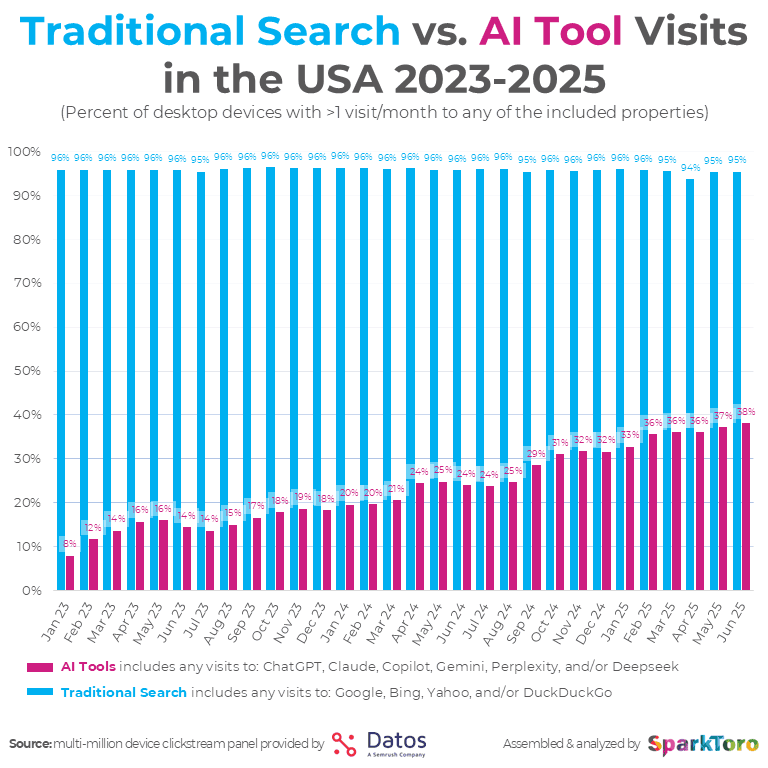
This isn’t the death of search. It’s the expansion of it.
The average person is still Googling for product reviews, how-tos and travel tips. What’s changed is where else they go to validate or explore those topics. AI tools have become part of the discovery process, not a full replacement for it.
If People Are Still Searching, What’s Actually Changing?
The biggest shift isn’t the act of searching. It’s the number of tools people now use to do it.
Search engines are still part of the routine. But so are AI tools, recommendation engines, voice assistants and even social platforms. The growth of ChatGPT and Perplexity may have surged early on, but adoption is now leveling out.
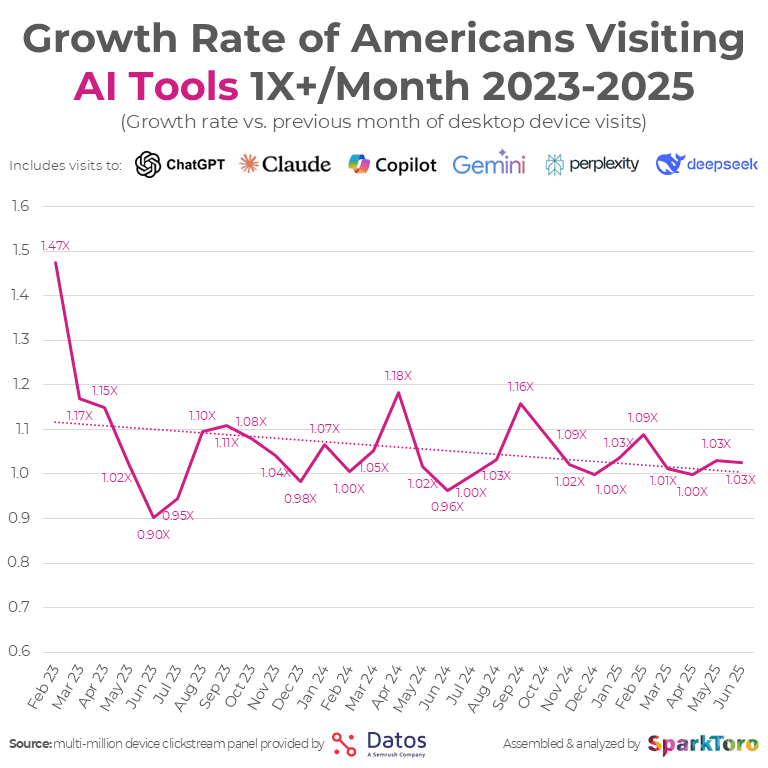
What matters is that users who embraced these tools early on are still using them. New users are joining slowly, not in massive waves. People aren’t switching from one tool to another but instead, they’re adding options to the mix.
That means your audiences are splitting their attention across more platforms. Your strategy should follow them.
Are AI Tools Replacing Search Engines or are they a New Extension of Them?
Short answer: AI tools are becoming an extension of the search experience, not a replacement.
In fact, Semrush found that after users began using ChatGPT regularly, their average weekly Google usage increased from 10.5 to 12.6 sessions, while they also used ChatGPT about five times per week.
This tells us that users aren’t leaving Google behind. They’re expanding their behavior. They’re checking AI results, validating them in search engines then bouncing to other sources for confirmation.
Search is quickly becoming more than just a “here’s your answer, take it or leave it” engine. It's becoming more of an ecosystem.
How Can Brands Start Being Found More in Both Traditional Search and AI Answers?
Now that we know visibility is expanding across audiences and across traditional search and AI-powered platforms, your strategy should follow suit. You don’t need to abandon what’s worked by any means, but you do need to start looking at how you can adapt. For many, there are four key areas you should focus on to increase discoverability across platforms.
Maintain or Update Traditional SEO Efforts
SEO is still doing heavy lifting. Ignoring it in favor of chasing AI visibility is short-sighted.
Simple, foundational SEO still matters: crawlable site structures, optimized page titles, metadata and well-organized content help both search engines and LLMs understand your content.
If your site isn’t optimized to rank today, it won’t magically get indexed and shown above others tomorrow. Whether a query is started through Google or in an AI platform, your content and website both need to be structured well to surface.
Content Structure Should Be a Top Priority
Structure matters. Not just because it helps in getting you found by your audience, but because it’s how search tools interpret your content.
Improving the readability and accessibility of your website content doesn’t have to be a major change. Instead, it’s continuing to focus on readability and accessibility by doing things like:
- Breaking large text blocks into digestible sections
- Using descriptive headers to guide readers
- Adding visuals or tables to simplify complex points
- Keeping paragraphs short and focused
Well-structured content is easier to skim, easier to understand and more likely to be surfaced by both AI models and search engines.
Do Better Keyword Research
Search has evolved beyond primary keyword matching. In some searches, focusing solely on a high-level keyword strategy may work and help you be found for that one search, but it doesn’t account for the other places you want to rank.
AI tools also use a process called query fan-out to surface the best responses. With query fan-out, the tools take the one search input you entered and spin it off into several related topics. So, it’s not just searching for that single keyword or phrase you optimized toward, it’s looking at secondary and tertiary keywords, phrases and questions.
To be visible, keyword research should go beyond the high-level, primary keyword options. You should start:
- Researching secondary and tertiary keywords
- Exploring how users phrase questions, then ask and answer those
- Expanding existing pages to address related concepts within a topic
Optimizing for more keywords creates more entry points for AI tools, for search engines and for people asking slightly different versions of the same question.
Create Content that Answers User Intent
Once you’ve done the research, it’s time to start developing content that actually serves user intent. Content that answers real questions wins. Especially when AI tools are pulling top-line takeaways, direct and clear answers help your content get included in responses.
If you aren’t already, you should be building a content strategy that includes:
- Building FAQ-style content into high-traffic or highly valued pages
- Including question-and-answer sections within longer articles
- Writing in a way that mimics how people ask, which has been important since voice search became ubiquitous in the mid-2010s
- Prioritizing clarity over fluff
These efforts help your content match user intent better and help to increase your chances of showing up when people ask AI tools or search engines for help.
Search in 2026 isn’t about choosing one channel or another. It’s about finding more ways to meet your audience wherever they’re looking for the information you have. And when your content is well structured, searchable and intent-based, your brand can become more available to more people in more places.
Need help being found in both traditional search and AI-powered discovery tools? Swanson Russell specializes in SEO, content strategy and digital discovery optimization. See the work we’ve created, get to know our approach — then, contact us to learn more about how we can help.


