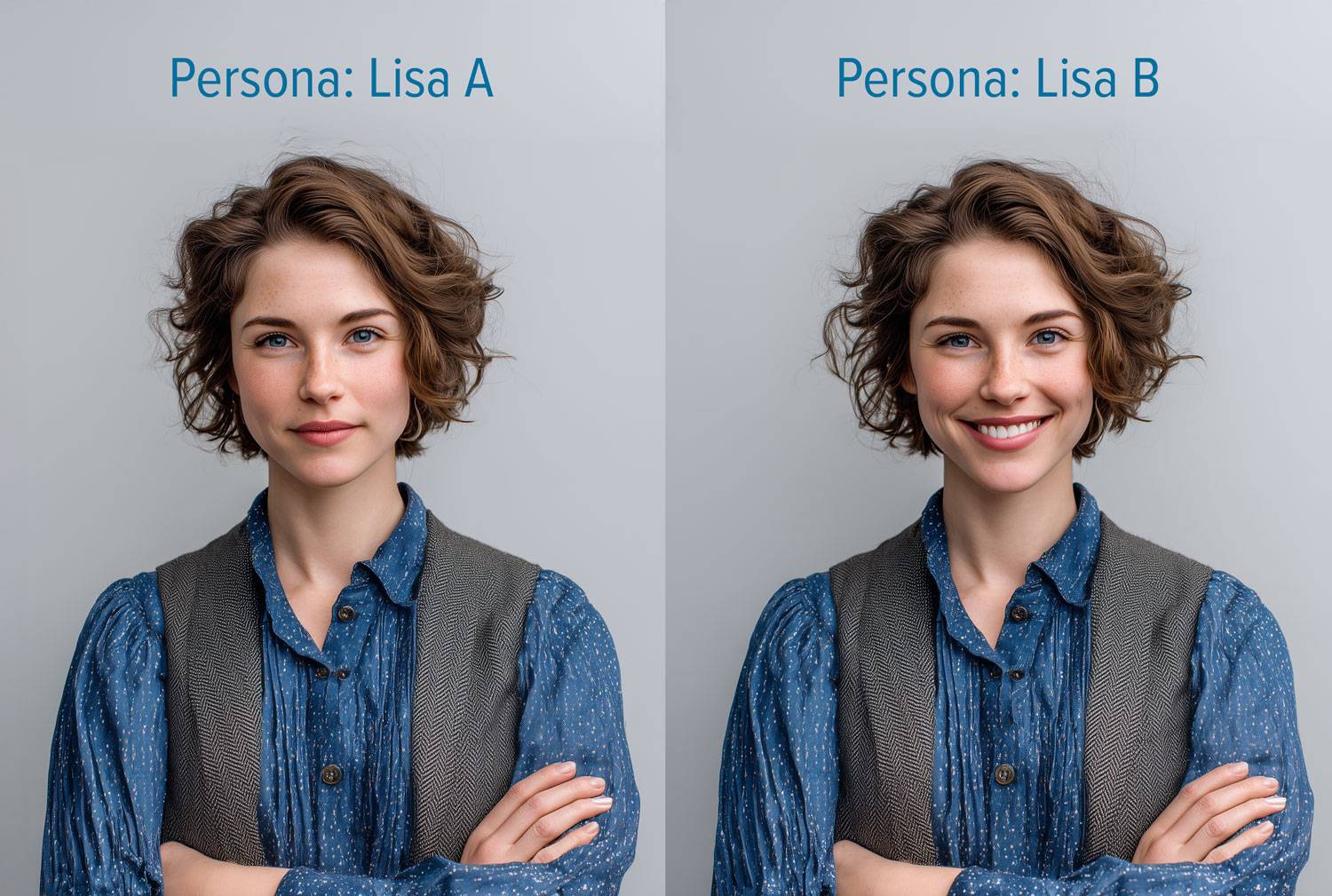
Lisa A vs. Lisa B
Lisa A presented as cautious and clear-spoken. She made rational arguments against risk. Her speech patterns were straightforward, practical and consistent with her life situation.
- “If it’s explained clearly and I know I can back out if I need to, then I’m a lot quicker to say yes.”
- “I want to do it, but it always feels like something for families with more wiggle room than I’ve got.”
She expressed emotion, but often in abstract or generalized terms. Her tone was steady and plausible, but her responses remained at the surface level.
Lisa B, the BME-enabled version, introduced more variation in phrasing, more emotional transitions and more nuanced language patterns.
- “I want to feel proud and secure, but that little voice of doubt doesn’t go away overnight.”
- “That fear can be louder than the logic.”
Lisa B also included more self-reflection and behavioral contrast:
- “During the research stage, the dominant driver is hope mixed with skepticism… In the consideration stage… self-doubt.”
- “If I clicked ‘submit’ or opened the account, I think I’d feel a mix of relief and pride — like, ‘Okay, I did it.’ But I also know myself, and I’d probably wake up the next day with a little bit of worry too.”
The BME version produced preambles (“Honestly...”), softeners (“I guess...”) and qualifiers that mirror real hesitation. The transcript demonstrated clearer emotional progression, internal conflict and belief recalibration across multiple questions.
Behavioral Differences and Strategic Implications
Across most evaluation criteria, Lisa B showed a higher degree of behavioral realism and strategic applicability.
1. Emotional Progression
Lisa B moved through research, hesitation and action readiness in sequence. She described her emotional state at each stage without being prompted:
- “In the research phase, I’m kind of hopeful but also cautious... By the time I get to final consideration, my mood shifts — I’m more anxious, second-guessing everything.”
This enabled clearer mapping of where intervention points exist — useful for experience design and message sequencing.
2. Message-Quality Language
Several lines from Lisa B could be directly extracted for brand or campaign messaging:
- “Your kid’s future doesn’t need perfection — it needs your effort.”
- “Start small, stay real and don’t wait for perfect.”
These weren’t generated from prompts asking for summaries or slogans. They emerged in natural responses to behavioral questions. Lisa A did not produce comparable phrasing.
3. Expressive Variation
Lisa A maintained a single tone: pragmatic, composed, even-toned. Lisa B shifted gears when appropriate — soft when vulnerable, concise when clear, indirect when uncertain. This variety supports brand voice modeling and message tone calibration.
4. Cognitive and Emotional Alignment
Lisa B said, “It’s like my brain gets the logic, but my gut still holds onto that fear.” That line captures belief friction precisely.
5. Design Utility
Several behavioral cues in the Lisa B transcript have immediate design implications:
- Her emphasis on reversibility (“I’d feel confident if I knew I could stop or change things if needed”) points to interface elements like editable plans, pause buttons or opt-out confirmations.
- Her reliance on social proof (“If I saw that someone like me could do it...”) supports testimonial content strategy and UGC campaign direction.
- Her desire for language without complexity (“No confusing terms, no surprises”) reinforces the need for plain language defaults and visual calculators.
These insights are not new in financial design. What’s significant is that BME-guided personas can generate them at scale, on demand, with behaviorally-aligned phrasing.
Strategic Takeaways
The results from the BME test revealed clear patterns of utility for real-world application. Behavioral modulation increased the precision, specificity and actionability of the persona’s responses. These gains apply directly to key disciplines: brand strategy, marketing execution, sales training and user experience design.
Marketing: Phrasing That Mirrors Real-Life Hesitation
The BME-enabled transcript generated emotionally attuned language that aligns with real decision friction. These were not aspirational statements. They were practical, belief-stage indicators:
- “That fear can be louder than the logic.”
- “I’d probably wake up the next day wondering if I made the right move.”
- “If someone like me can do it, maybe I can too.”
These quotes support creative that speaks from the audience’s internal voice rather than the brand’s external positioning. They serve as input for messaging platforms where tone matching is critical.
Use Cases: Landing pages, retention messaging, audience-specific ad language, financial literacy tools.
Brand Strategy: Emotional Themes That Anchor Positioning
Lisa’s belief structure, when shaped through the BME, presented recurring emotional drivers: protection, risk management, small-proof confidence and quiet pride. She framed progress in terms of control:
- “I just need to feel like I can stop if I need to.”
- “Even $5 a month makes me feel like I’m doing something right.”
These patterns define an emotional landscape that brand platforms can adopt. They also serve to reframe traditional benefit language through values like resilience and consistency over ambition or aspiration.
Use Cases: Strategic messaging guides, belief-driven brand narrative development, persona-led voice systems.
Sales Training: Conversational Patterns That Reveal Readiness
The BME-driven transcript supplied language that signals readiness cues, hesitation triggers and support requirements:
- “I don’t want to feel like I’m locking myself into something I can’t undo.”
- “I’m looking for signs that this was made for people like me.”
- “It’s not that I don’t want to do it — I’m just afraid I’ll regret it.”
These responses guide sales and service teams to recognize emotional subtext. The phrasing can be embedded in advisor scripts, objection handling and advisor enablement content to support more aligned conversations.
Use Cases: Training materials, call scripts, CRM conversation flags, peer-model onboarding flows.
Experience Design: Friction Cues That Inform Interface Priorities
Lisa B emphasized the role of ease, reversibility and emotional reassurance in platform interactions:
- “I want a tracker that shows I’m getting somewhere — even slowly.”
- “Just one screen that shows me how to start small and stay in control.”
These are clear directives for UI teams building tools for high-friction decisions. They offer tactical insight into where to place flexibility messaging, how to visualize small gains and what types of confirmation language reduce abandonment.
Use Cases: App interface copy, enrollment flows, post-action feedback messages, milestone nudges.
The impact of behavioral modulation in this test was measurable. It gave teams across disciplines clear, unambiguous inputs tied to emotional behavior without requiring synthesis or inference. This makes the output useful not only for insight gathering but also for immediate execution.
Improving Belief Visibility to Improve Utility
Synthetic personas are increasingly used to inform strategy, but many remain limited to static snapshots or overgeneralized behavioral summaries. They often reflect what people say in surveys or focus groups, not how they move through complex decisions over time.
This test confirmed that emotional modulation improves usability. When a persona can articulate the moment they hesitate, what they need to hear to keep going or what shuts them down mid-decision, the insight becomes operational.
Lisa’s BME-guided transcript revealed belief-stage shifts in her own words. She described how her thinking evolved between research and action. She explained what kind of confirmation would calm her down. She named who she listens to and why. These weren’t researcher interpretations — they were sourced directly from the persona’s language.
That matters in applied settings. Creative teams need message framing that won’t trigger defensiveness. Experience designers need to know where perceived risk stalls momentum. Sales and service teams need phrasing that builds trust with people who already expect to feel left out.
Without structured modulation, these kinds of insights depend on guesswork or post-simulation analysis. In systems like ours with BME, they’re built into the transcript. The behavioral logic is already embedded. This changes the role personas can play in go-to-market work. They move from reference tools to decision-support tools — able to drive message tone, timing, flow and framing across functions.
Experience BME-Driven Personas
If you’re working on messaging, product design or sales strategy for audiences who face real tradeoffs, access to structured behavior modeling can make a profound difference.
Our Behavioral Modulation Engine is proprietary. We don’t publish the internal architecture, but we do make the output available to clients who need high-empathy, high-fidelity persona inputs for real decisions.
We offer access to transcripts, synthesis and applied insights that show how belief-stage behavior appears in natural language — and how that behavior can be used to shape creative, platform and communications strategy.
If you're building something that depends on trust, clarity or emotional friction, we can show you what it looks like when the simulation supports all three.